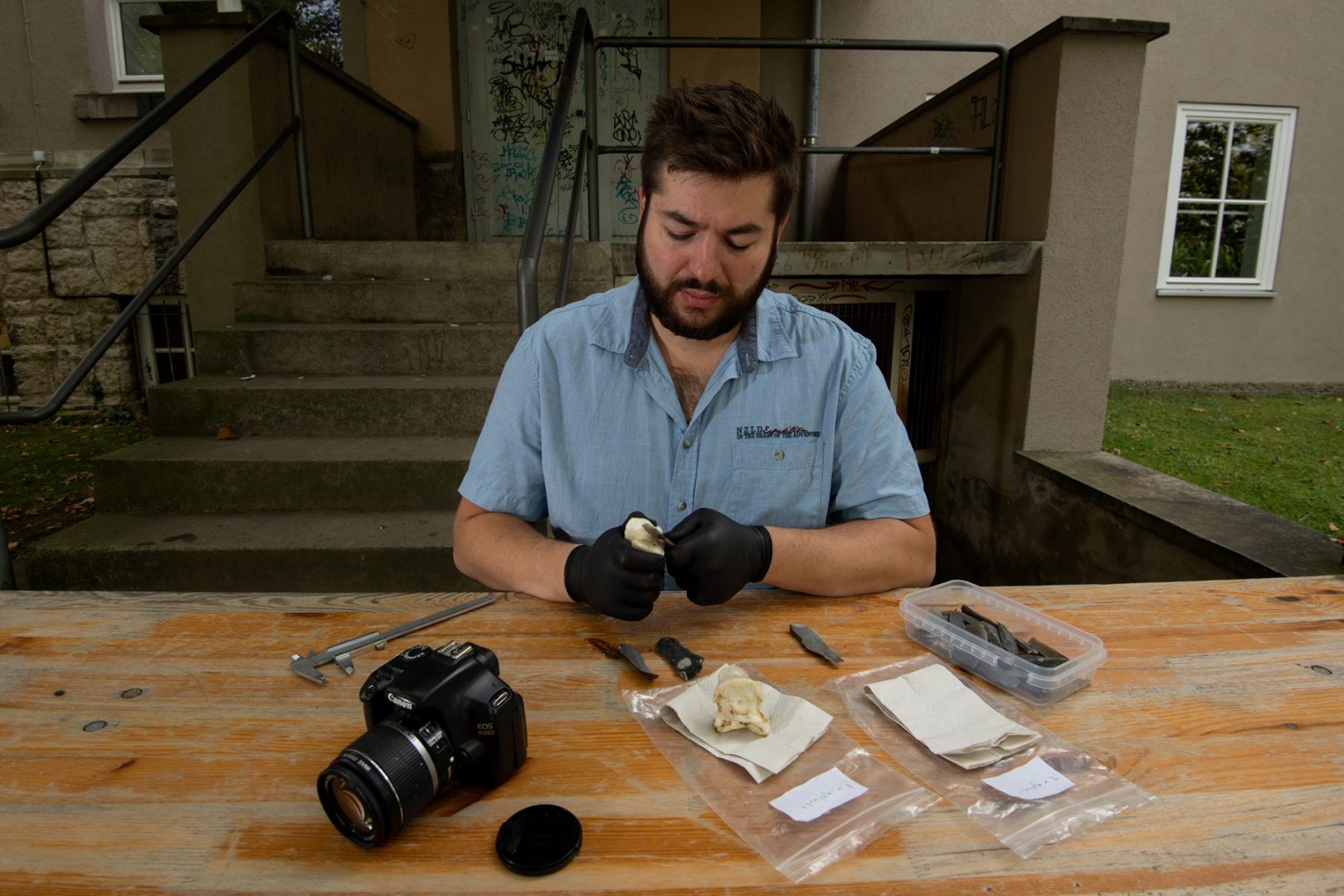
At the University of Göttingen, Germany, we met Dr. Raphael Hermann, who is a research assistant in the ERC project WEIGHTANDVALUE, but also was responsible for carrying out the experiment to better understand how 50,000 years ago, Neanderthals could carve so precisely the engravings onto a giant deer bone. He learnt that the bone must have been boiled for at least 2-hours before being carved with a stone flint of some kind. He made his experiment outside because the smell was too intense. In the summer of 2021, researchers announced the discovery of the first directly-dated piece of Neanderthal art: A distinctly-carved bone from a now extinct giant deer (Megaloceros giganteus). It was excavated from sediments that blocked an ancient entrance to Einhornhöhle (Unicorn Cave) in Germany’s Harz Mountains. Most Important to researchers, the bone featured a deliberate engraving in the form of a chevron, indicating that Neanderthals had the capacity for symbolic thinking—and what some researchers believe is “art.”These findings were recently published in the journal Nature Evolution & Ecology.