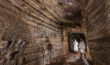
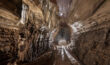
Here, team members Dr. Alexis Ndongo and Dr. Ndukauba Egesi examine the cave wall stratigraphy. The caves of Ngounié Province are developed in ancient sedimentary rocks deposited around 650 million years ago, before complex life forms evolved on Earth. Here, the strata alternates from light coloured carbonates to dark coloured clayey siltstones reflecting periodic rising and falling of sea level under natural variations in Earth’s climate. The problem with climate change today is the speed and magnitude of the change over less than 200 years.
This project aims to generate the first-ever record of seasonal rainfall variability for West and Central Africa from stalagmites in caves. Why stalagmites? Stalagmites preserve a record of past climate in their mineral structure within rings of growth similar to that of trees. The layers are deposited by cave ‘drips’ that fall from the ceiling of the cave onto the stalagmite. Every single drip carries with it a chemical record of its history...from its time in the atmosphere falling as rain, to its time passing through the soil and rock above the cave. The unique chemistry of each drip that is preserved in the stalagmite layers gives us a snapshot into the past climate (temperature & rainfall) and vegetation (reflected in the soil chemistry) above the cave when that layer was deposited.